The core difference between active filters and passive filters is whether they rely on external power supplies and the use of active devices. Active filters are suitable for low frequency, high precision and signal amplification scenarios, while passive filters are more advantageous in high frequency, high power and simple applications. Performance, cost, and complexity need to be balanced according to specific requirements.
Active filter and passive filter are two common filter types in electronic circuits, and they have significant differences in structure, performance and application scenarios.
一、Definition and core composition
Active filters contain active devices (such as operational amplifiers, transistors, etc.) that require an external power supply to operate, usually consisting of resistors (R), capacitors (C), and operational amplifiers (Op-Amp), and are non-inductive (L) designed for low-frequency applications (such as audio ranges).
Active power filter picture
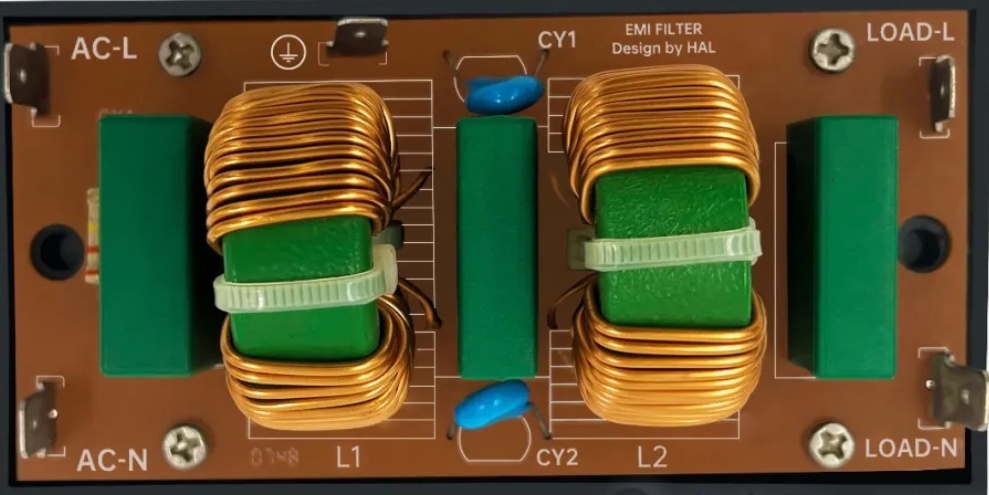
Passive Filter consists of only passive components (resistors, capacitors, and inductors) and does not require an external power supply. The passive filter is simple in structure, but requires an inductor (L), resulting in a large volume. It is often used in high-frequency or high-power scenarios (such as RF and power filter).

Passive filter picture
二、Performance difference
Active filters are suitable for low frequencies (usually less than 1 MHz), low output impedance, low load impact, can be designed with high Q frequency selection characteristics, can provide signal gain (amplification) through the operational amplifier circuit, but the operational amplifier circuit may introduce nonlinear distortion (need to select high-performance devices).
Passive filters are suitable for high frequencies (up to GHz level, such as radio frequency circuits), the output impedance is high, load changes may affect the filter performance, the Q value is limited by the characteristics of the passive component, usually low, no gain, the signal may be attenuated (insertion loss), the passive component linearity is high, and the distortion is small.

Dielectric filter
三、Comparison of advantages and disadvantages
Advantages of active filter: small size (no inductance required), suitable for integrated design (such as IC chip); Strong flexibility, can achieve high order filtering (such as Butterworth, Chebyshev and other complex responses); Provides gain and compensates for signal attenuation. Disadvantages: dependent on power supply, high power consumption; Limited by the bandwidth of operational amplifier circuit, the high frequency performance is poor. High cost (need to use active devices such as op-amps).
Advantages of passive filter: no power supply, high reliability, suitable for harsh environments; High frequency performance (such as radio frequency circuit); Low cost, simple structure. Disadvantages: the inductor is large and difficult to integrate; The signal may be attenuated (no gain); The high level design is complex (requires multiple levels of LC combination).

LTCC filter
四、Application scenario
Active power filter is mainly used in audio signal processing (such as equalizer, low-pass filter); Sensor signal conditioning (suppress noise, improve SNR); Baseband processing in communication systems (e.g. anti-aliasing filtering).
Passive filters are mainly used in radio frequency (RF) circuits (such as antenna matching, frequency band selection); Power noise filtering (e.g. EMI suppression); Power electronic systems (such as harmonic suppression).

LC filter
五、Selection suggestion
Using active filters requires gain, low frequency applications, small volume design, and complex filtering characteristics (such as high order or tunability). The passive filter needs: high frequency (>1 MHz), high power, low cost, no power supply occasions (such as RF or power purification).